Business
The Price of Personalization
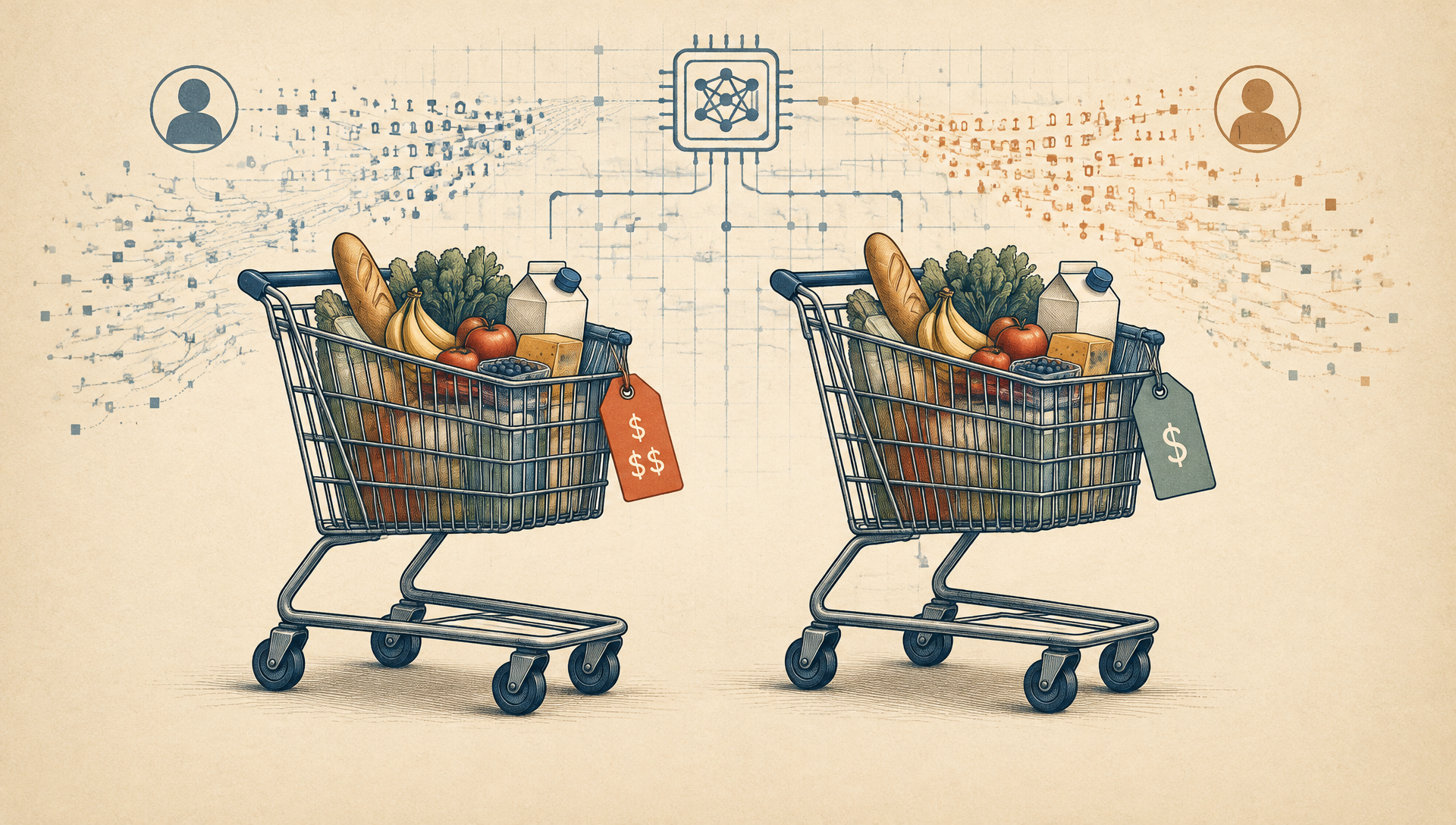
Imagine two customers buying the same product from the same retailer, but paying different prices. Neither uses a coupon or negotiates; instead, an algorithm predicts how much each is willing to pay based on their data.
From Market Prices to Individual Prices
Businesses have long adjusted prices to reflect market conditions. Airlines raise fares as seats fill, while hotels lower rates during slower periods. Personalized pricing goes further, using data such as browsing history, past purchases, and location to estimate individual consumers' willingness to pay. As a result, two customers may receive different prices for the same product, even when they cost the retailer the same to serve. The incentive is simple: a single price may undercharge customers willing to pay more or drive away those who need a discount. AI allows businesses to predict these differences across millions of customers, turning what once required individual negotiation into a scalable pricing strategy.
Consider a retailer selling a product that costs $40 to acquire. One customer would pay $100, while another would pay only $60. Charging both customers $60 generates $40 in total gross profit. Charging the first $100 and the second $60 doubles that amount to $80. The example illustrates the potential gains from reducing the information asymmetry between seller and buyer; but it also exposes the central tension in personalized pricing. The firm's ability to extract additional consumer surplus depends on how accurately it can estimate each customer's reservation price, or the maximum amount that customer is willing to pay.
At scale, personalized pricing becomes a problem of constrained optimization, as firms must balance profit per sale against the likelihood of making that sale while accounting for differences in consumers' price sensitivity. Using statistical inference, algorithms estimate consumers' willingness to pay from past behavior, but these predictions remain imperfect. Preferences change, historical data may be unrepresentative, and correlation does not necessarily imply causation. Research by economists Jean-Pierre Dubé and Sanjog Misra, published in the Journal of Political Economy, illustrates this trade-off. Their study found that personalized pricing increased firms' expected profits while reducing total consumer surplus, even though more than 60% of consumers in their experiment benefited. These findings show how aggregate outcomes can obscure the distribution of gains and losses, since most consumers can benefit individually while consumers as a group are still worse off.
When Efficiency Becomes Exploitation
The distinction between useful personalization and exploitation becomes more difficult when companies use personal behavior to set prices. In January 2025, the Federal Trade Commission released initial findings from its study of surveillance pricing. The agency reported that pricing intermediaries could use information including location, browsing activity, and shopping history to help businesses tailor prices and promotions. These findings illustrate the breadth of information available to pricing systems, although they do not establish that every retailer uses individualized prices.
The economic concern is not simply that customers pay different amounts. Price discrimination can increase output when lower prices make products accessible to consumers who would otherwise be priced out of the market. The more difficult question is whether firms use personal information to distinguish genuine differences in price sensitivity from differences in consumers' ability to refuse a transaction.
A model built to maximize immediate revenue may identify customers with urgent needs, few alternatives, or relatively inelastic demand, allowing firms to raise prices without losing many sales. But this can also mean charging more to consumers with less bargaining power. This reflects a problem of objective specification: algorithms optimize for the goals they are given. When immediate revenue outweighs consumer welfare, privacy, and long-term loyalty, a model can succeed by its own metrics while producing undesirable outcomes.
The risks are especially significant in markets for essential goods and services. Consumers may have little choice between providers or may be unable to delay a purchase. Their demand is therefore relatively inelastic, allowing firms to raise prices without losing many customers. When algorithms use these differences to personalize prices, they can deepen existing inequalities in bargaining power rather than improve market efficiency.
Consumers also face an information disadvantage. They rarely know what factors determined their price, how much those factors mattered, or what other customers were charged. Without that information, it is difficult to tell whether a price reflects market conditions or an algorithm's assessment of their personal circumstances. This lack of transparency limits consumers' ability to compare offers, negotiate, and make informed decisions.
The Unequal Costs of Personalized Pricing
Personalized pricing also raises concerns about racial, gender, and wealth inequality. Although algorithms do not need to use race or gender directly to produce unequal outcomes, they can rely on proxies such as ZIP code, purchasing history, and browsing behavior that correlate with existing social and economic differences. Research on algorithmic bias has shown how seemingly neutral systems can reproduce historical disadvantages when their data or assumptions reflect unequal conditions. In pricing, this creates the risk that consumers with fewer alternatives or less bargaining power will consistently face worse offers.
Wealth inequality makes this trade-off especially complicated. A model may interpret frequent purchases, expensive browsing habits, or a willingness to pay full price as evidence that a customer can afford more. Yet willingness to pay does not necessarily reflect wealth; it may reflect urgency, limited options, or a lack of time to search for alternatives. If algorithms prioritize revenue over fairness, they may extract more from consumers who cannot easily refuse a purchase while offering discounts to those with greater flexibility. The result could be a system that rewards purchasing power rather than need.
These risks are difficult to detect because AI systems can make discriminatory patterns appear objective. Even when companies exclude protected characteristics from their models, other variables may serve as indirect proxies for them. The Federal Trade Commission's 2025 findings on surveillance pricing highlight how companies can use location, demographics, browsing activity, and purchase history to tailor prices and promotions. Although these findings do not establish that personalized pricing systematically discriminates by race or gender, they underscore the need to examine who benefits from algorithmic decisions and who bears their costs. Without transparency and regular audits, personalized pricing could reinforce existing inequalities while concealing them behind seemingly neutral calculations.
The Hidden Cost of Higher Profits
Personalized pricing may boost immediate revenue but damage long-term customer relationships. Consumers judge not only the price they pay, but how it was determined. A 2022 study by Hufnagel, Schwaiger, and Weritz in the Journal of Business Research found negative reactions to personalized pricing even among customers who received favorable prices, with perceived price fairness helping explain these responses.
A discount may not offset the feeling of being manipulated. When consumers discover that their personal data shaped what they paid, trust can erode, discouraging future purchases and damaging a firm's reputation. Flexible pricing still has benefits; discounts can help price-sensitive consumers, and dynamic pricing can allocate limited capacity. The challenge is to use consumer data to meet different needs without exploiting people's limited choices or information.
Pricing in an Algorithmic Economy
As pricing algorithms become more sophisticated, the question is not whether businesses should use data, but how they should use it responsibly. Transparency about how demand, availability, and consumer information shape prices can help preserve trust, particularly when customers cannot inspect or challenge the inferences behind personalized offers. Regulators must balance the benefits of flexible pricing with protections against deceptive or discriminatory practices. Greater firm efficiency does not necessarily improve social welfare; how surplus is distributed, what alternatives consumers have, and how pricing affects competition all matter.
Ultimately, algorithms can optimize for a given objective, but they cannot determine whether that objective is fair. The metrics firms prioritize reflect economic choices, not just technical ones. Effective pricing must balance immediate profits with long-term consumer trust: predicting what someone will pay is not the same as deciding what they should be charged.